


Michael Levin asked 68 scientists including myself: What is life? We came back with 68 different answers.
My definition was the least “lab-coat” of the bunch. On purpose.
Mike’s paper is called What Lives? A Meta-Analysis of Diverse Opinions on the Definition of Life. It maps everyone’s answer on a graph.
Defining life is notoriously slippery. No two biologists give the same answer. No definition captures all life does.
This is not merely a linguistic problem. No string of human syllables captures what conscious living beings are and do.
I’m all for trying to discover life, break it down, model it, analyze it, research, build, improve and extend it — but it’s so much greater than our words and concepts. Life is ineffable.
My definition:
“Life is the fire that lights itself. Self-awareness and self-agency — not just an act of creating, but the continual gift of creativity, the potenza for singularity in every single moment, ineffable.”
Some scientists don’t know what to do with a statement like “Life is the fire that lights itself.” But in choosing to define it this way, I’m calling out the elephant in the room.
50 years ago Maturana and Varela coined the term autopoiesis. It means self-creation. Like a watch that assembles itself out of a pile of springs and gears, then winds itself up.
How does anything create itself?
Nobody knows. Yet when you watch an embryo assemble itself, that’s exactly what you see.
The profession sweeps this question under the rug with clever rhetoric: “Evolution through natural selection.”
‘Evolution through natural selection’ is backwards. Real life is “Natural selection through evolution.” Why? Because you have nothing to select until after the evolutionary event has occurred.
Natural selection is an outcome, not an explanation.
Natural selection is not the cause. It is the effect.
“Evolution through natural selection” is a shell game. “Life is the fire that lights itself” is not. It’s a fitting metaphor. An artistic statement that hints at the nature of this yet-unsolved mystery.
I define “Self-awareness and self-agency, not just an act of creating but the continual gift of creativity” in other papers. In Biology Transcends the Limits of Computation, I show that life does inductive reasoning — it makes decisions that cannot be mathematically determined.
Life makes choices, and those choices create information.
Axioms are chosen rules for building a world. An axiom could be “I’m going to map locations using X and Y coordinates.” (Euclidean geometry.) A different axiom could be “I’m going to map locations using latitude and longitude coordinates.” (Spherical geometry.) Axioms don’t make themselves; they are chosen by agents. All living cells are agents.
“Fire that lights itself” translated into formal language is “self-generating axioms.” That would be my lab-coat definition. But I didn’t put it that way because it doesn’t convey the full idea. Axioms are flat and boring. Fire crackles with energy. So does life.
Stuart Kauffman, Sy Garte and I, in The Reasonable Ineffectiveness of Mathematics in the Biological Sciences, we prove biology does not merely obey mathematics, it creates mathematics. In biology there is almost no such thing as a math formula that is 100% true.
In the 1940s, legendary physicist Erwin Schrödinger called this creative force negentropy, or negative entropy.
Entropy causes fire to burn out.
Negative entropy is fire that lights itself.
Nothing can reverse conventional heat entropy. But by manipulating information, life can increase physical order. Despite the fact that total entropy still increases according to the 2nd law of thermodynamics.
When you clean your room, you reduce information entropy. Heat entropy has no reverse gear. Information entropy does. This reversal, from disorder to order, happens every time any person, plant or animal makes a decision.
I love the Italian word “Potenza.” More flavorful than English potential. When I say “singularity in every single moment” I am saying that most of the time, a cell runs its program. Yet at any point in time a surprise can come along, and the organism can make a choice not calculable from a prior state. A singularity.
Evolution is not random events; it’s response to random events. The creative power of life.
Humans are not wind-up toys; nor are the cells we are made of. This is why biology cannot be reduced to fixed physical laws. That’s why science as traditionally defined — reducing the cosmos to equations — will never capture biology.
Two options: Upgrade the definition of science to fit what biology does. Or keep pretending the problem will go away.
Science lags because its tools aren’t mature yet. We are only at the foothills of understanding life. Artists, poets and musicians capture the essence of life better than scientists.
Oxford scientist Andrew Briggs wrote The Penultimate Curiosity. Subtitle: “Science swims in the slipstream of ultimate questions.” He explores the Big Questions that have captivated humans for 100,000 years.
Briggs shows how theology, philosophy, poetry, and the arts pose questions centuries ahead of what science can analyze and digest.
~
So… what is this paper about?
It maps our spectrum of definitions.
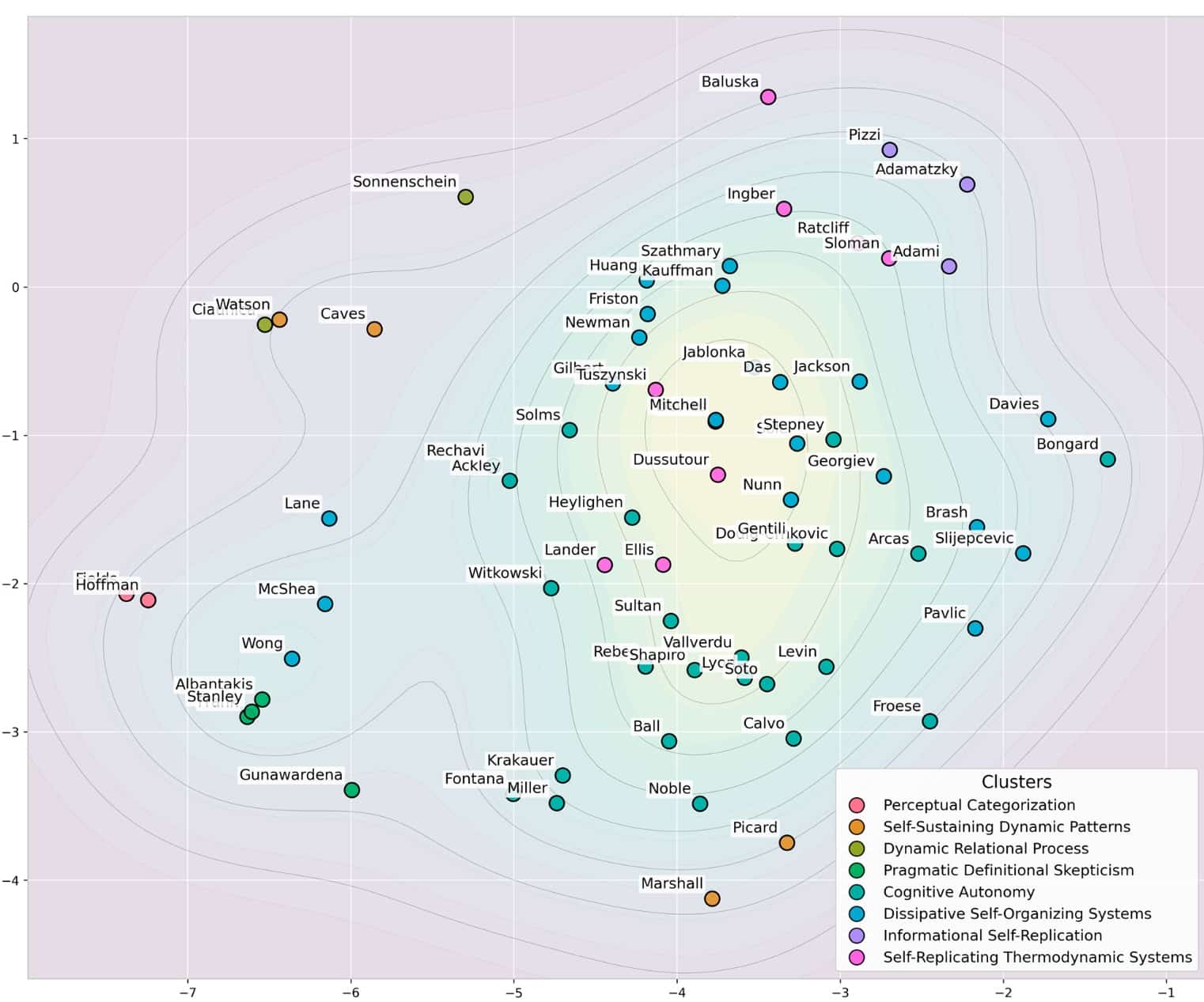
X-Axis: On the left, those who feel the line between life and non-life is an artificial human construct. On the right, those who say it’s an objectively measurable distinction.
Y-Axis: On the bottom, those who see life as a process; on the top, those who classify life in terms of its ingredients.
Perspective: 57% of definitions take an objective stance (life is observer-independent); 43% take subjective points of view.
Nature: 46% treat life as alive / not alive; 54% as a continuum.
Approach: 88% actionable / conventional; 12% inspirational, poetic, or self-recursive.
What Lives? A Meta-Analysis of Diverse Opinions on the Definition of Life paper in the journal Biological Theory.
Props to Mike Levin for inviting me. I’m proud to be the outlier at the edge of the chart.
Perry Marshall
P.S.: Over the last few decades people somehow got the idea that scientific papers are supposed to be flat, boring and impersonal. Written in dreadful, droning, false-authority passive voice. When you read papers from 50-100 years ago, they often include anecdotes, quotes from literature, poetry and personal opinions. It’s time to bring personality, passion and fire back into science.
~
Download The First 3 Chapters of Evolution 2.0 For Free, Here – https://evo2.org/evolution/
Where Did Life And The Genetic Code Come From? Can The Answer Build Superior AI? The #1 Mystery In Science Now Has A $10 Million Prize. Learn More About It, Here – https://www.herox.com/evolution2.0
Thank you for the link to the paper. However, my message is about negentropy. First, Schrödinger himself has not connected negentropy with information. Second, Schrödinger himself acknowledged that one should have better spoken of free energy, and his use of entropy was just to express thermodynamics in a popular manner.
Yet, his language brought more problems then solutions. A nice treatment of thermodynamics in biology is in Corning&Kline [1], see also my paper about negentropy [2].
In general is is unlikely that one could connect thermodynamic entropy with biological organization. There is a nice quote on what one could expect from thermodynamics in biology in Müller’s A History of Thermodynamics [3]:
“If the truth were known, thermodynamics would be seen as explaining little about the details of life functions in animals and plants, at least compared to what there is to be explained. This is no different than with engines: Thermodynamics cannot provide a recipe for their construction, or give information about where and how to arrange seals and boreholes for lubrication, and how to operate the valves and where to install them. What thermodynamics can do about engines is to give an account of the balance of in- and effluxes of mass, momentum, energy and entropy, and that is essentially what it can also do about life. For the engine that task has been done satisfactorily; for animals and plants maybe there remains something to be done.”
The main problem is that it is hard to say what entropy of organism is. The experimental values are available for microbes only. And these results show that the connection with the structure is not there. Let me quote from the first paper with experimental entropy [4] (Saccharomyces cerevisiae):
“The absolute entropy/g of the yeast cells falls within the range of those for simple biological molecules like sugars and amino acids and more complex biopolymers like proteins. We conclude that the thermodynamic effect of cellular organization in the dried cells is negligible.”
1. Corning, P. A., & Kline, S. J. (1998). Thermodynamics, information and life revisited, Part I: ‘To be or entropy’. Systems Research and Behavioral Science: The Official Journal of the International Federation for Systems Research, 15(4), 273-295.
2. Evgenii Rudnyi, Erwin Schrödinger and Negative Entropy, 2025, preprint, doi:10.20944/preprints202509.1729.v1
3. Ingo Müller, A History of Thermodynamics. The Doctrine of Energy and Entropy, 2007.
4. Edwin H. Battley, Robert L. Putnam, and Juliana Boerio-Goates. Heat capacity measurements from 10 to 300 K and derived thermodynamic functions of lyophilized cells of Saccharomyces cerevisiae including the absolute entropy and the entropy of formation at 298.15 K. Thermochimica acta 298, no. 1-2 (1997): 37-46.
Evgenii,
Thank you for your astute comment. You’re right, Schrodinger does not connect negentropy with information. I do.
I explain this in two papers:
Biology Transcends the Limits of Computation
https://doi.org/10.1016/j.pbiomolbio.2021.04.006
and
The Role of Quantum Mechanics in Cognition Based Evolution.
https://www.sciencedirect.com/science/article/pii/S007961072300041X
Here I say that a single binary cognitive decision by a cell generates one bit of negative information entropy – in other words it creates one bit of information. This stands in contrast to merely transmitting/storing information in the Shannon sense, which you measure information by counting its bits; which is also in contrast to obscuring one bit of information (information entropy) where the information is lost when you do not know whether the original was a 1 or a 0.
In the quantum mechanics paper, I say that a cell, acting as a quantum observer, exhibits a preference and “collapses a wave function” to a 1 or 0 and therefore instantiates its choice in the physical world. Which might be opening a gap junction or ion channel for example.
Shannon in his 1948 paper never considered where the information originates or how. I believe this model accounts for the creation of information. Anyone familiar with Maxwell’s demon understands how in theory information can reverse thermodynamic entropy locally and incur a global energy cost of generating the information and not cheat the 2nd law.
By analogy, I believe my information negentropy model elegantly explains how organisms consume energy to fuel their intelligence and then use that intelligence to order the world around them. =Evolve.
You may like Kaklyugin–Norman Postulate “The collapse of the wave function is a quality inherent in livingmatter”. It has been proposed in a Russian paper in 2000:
A. S. Kaklyugin, and G. E. Norman. “Hierarchical approach as the generalization of vitalism and reductionism.” Ross. Khim. Zh 44, no. 3 (2000): 7.
Now it is also described in the paper in English
A. V. Lankin, and G. E. Norman. “Introduction to quantum mechanics of living matter.” Russian Journal of Physical Chemistry A 99, no. 6 (2025): 1416-1445.
https://www.researchgate.net/publication/392707013_Introduction_to_Quantum_Mechanics_of_Living_Matter
I personally do not believe that this is the right way to go. Anyway, you might find it useful for your future works.
Thank you that is a very interesting resource. It overlaps with my “Role of Quantum Mechanics in Cognition based Evolution” paper quite a bit. I was not aware of it before now.